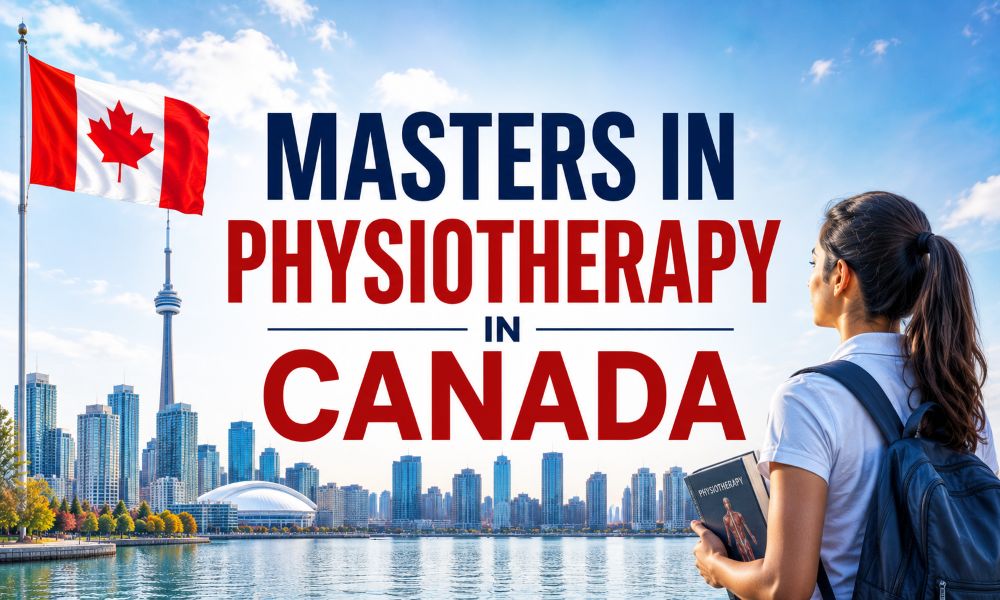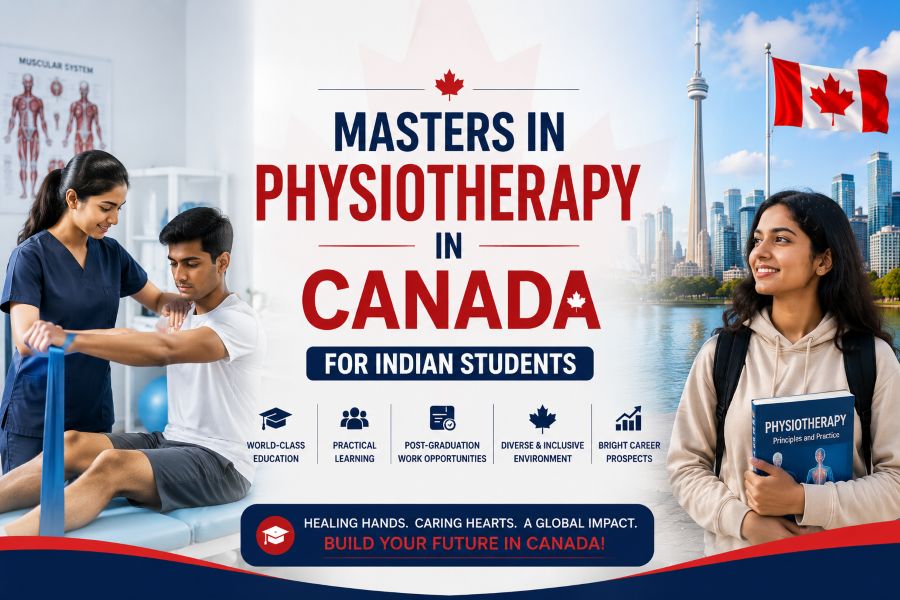

Masters in Physiotherapy in Canada
Table of Contents
- Why Masters in Physiotherapy in Canada ?
- Top universities for Masters in Physiotherapy in Canada
- Who are eligible to enroll for Masters in Physiotherapy in Canada ?
- Tuition fee for Masters in Physiotherapy in Canada
- Scholarship grants for Masters in Physiotherapy in Canada
- How to Apply for Masters in Physiotherapy in Canada?
- Job placements after Masters in Physiotherapy in Canada
- Conclusion
A Master's in Physiotherapy in Canada often called MScPT or MPT, an intensive, 2 to 3 year entry practice professional degree. It blends classroom theory with over 1,000 hours of clinical placements to prepare you for licensure as a registered physiotherapist. It is a top professional qualification sought after by clinical aspirants globally.
This advanced clinical degree features an intensive curriculum that equips international graduates with diagnostic and manual therapy skills.
Designed explicitly for ambitious Indian medical and kinesiology graduates, this comprehensive manual maps the structural expectations, exact tuition figures, and university timelines for the upcoming 2026 intakes.
Key Highlights: Masters in Physiotherapy in Canada
The quick reference dashboard below presents the core logistical and structural data points concerning the 2026 clinical intake across Canadian territories.
Core Criteria Element | Strategic Program Specifications |
Primary Degree Title | Master of Physical Therapy (MPT) / Master of Science in Physical Therapy (MScPT) |
Academic Standing Type | Coursework based Professional Graduate Degree |
Standard Course Duration | 2 Years to 2.4 Years (24 to 28 continuous months) |
Total Program Credits |
|
Annual Tuition Fee Range | CAD 18,000 to CAD 50,000 (approx. ₹11.16 Lakhs to ₹31.00 Lakhs) |
Prerequisite Clinical Hours | Minimum 40 to 100+ hours of verified volunteer/paid clinical work |
Professional Licensure Path | Graduates are eligible to challenge the PCE (Physiotherapy Competency Exam) |
Why Masters in Physiotherapy in Canada ?
Enrolling in a Masters in Physiotherapy in Canada establishes a pathway to becoming a highly compensated practitioner in a nation experiencing an escalating demand for musculoskeletal specialists.
The Canadian healthcare model places extensive emphasis on clinical reasoning, giving physical therapists high structural autonomy.
World Class Practicum Training: Programs alternate intensely between classroom biomechanics seminars and structured hospital rotations to solidify clinical instincts.
Streamlined Permanent Residency Paths: Graduates can claim a Post Graduation Work Permit (PGWP) lasting up to 3 years, serving as an invaluable asset for accumulating CRS points via Express Entry.
Regulated Professional Autonomy: Physiotherapists in Canada operate as direct access healthcare practitioners, allowing them to diagnose patients independently without requiring a baseline medical doctor referral.
Top Tier Global Salaries: The growing demographic shifts across aging Canadian provinces assure exceptionally high clinical placement percentages and lucrative entry packages.
Top universities for Masters in Physiotherapy in Canada
The institutional landscape across Canada features prominent, publicly funded universities renowned globally for advanced health and rehabilitation sciences research.
Selection processes are highly competitive, prioritizing applicants with solid clinical and biological foundations.
Selecting an accredited university ensures your master's degree satisfies provincial licensing credentials.
The following premium medical institutions are recognized globally for delivering top tier training for the 2026 cycle:
Top Tier Canadian University | 2026 Global Overall Rank | 2026 Life Sciences & Medicine Rank |
McGill University | 27 | 28 |
University of Toronto | 29 | 12 |
University of British Columbia (UBC) | 40 | 25 |
University of Alberta | 94 | 93 |
Western University | 151 | Top 150 |
McMaster University | 173 | 56 |
Queen's University | 191 | Top 250 |
Curriculum Structure and Study Modes
The academic framework for a Masters in Physiotherapy in Canada demands full time, rigorous, continuous engagement across multiple consecutive blocks.
The structure systematically weaves foundational anatomy with extensive clinical placement hours to foster professional readiness.
The table below compiles the operational mechanics and core structural criteria of the curriculum.
Academic Operational Pointer | Curriculum Formatting and Delivery |
Standard Duration | 24 to 28 Months (Delivered continuously across 6 to 7 continuous terms) |
Study Delivery Framework | Strictly On Campus (Full Time) due to mandatory hands on clinical lab work |
Integrated Clinical Placements | 1,000+ Hours of supervised clinical work integrated internships |
Core Systems Covered | Musculoskeletal, Neurological, and Cardiorespiratory systems management |
Graduation Milestone | Submission of a Group Capstone Project, Comprehensive Exam, or Clinical Portfolio |
Full Time On Campus: The exclusive delivery mode available for international student visa holders, ensuring rigorous peer to peer laboratory practice.
No Online Options: Regulatory licensure bodies do not permit entry to practice physical therapy paths to be delivered in part time or online variations.
Who are eligible to enroll for Masters in Physiotherapy in Canada ?
Gaining entry to a Masters in Physiotherapy in Canada demands fulfilling highly stringent prerequisite baselines. Because class sizes are structurally restricted to protect low student to faculty lab ratios, meeting the minimum bar is vital. Fulfil following requirements to apply:
Academic Prerequisite Degree: A 4 year undergraduate degree in Kinesiology, Human Kinetics, Physiology, or a highly related health science discipline.
Grade Baseline (GPA): A minimum calculated sub GPA of 3.0 out of 4.0 (translating to roughly 70% to 75% or a first class division in Indian bachelor transcripts).
Specific Course Prerequisites: Verified university level credits in Human Anatomy, Human Physiology, Statistics, Psychology, and foundational Physics.
English Proficiency Standards: Exceptional linguistic clarity is mandatory; standard requirements sit at IELTS: 7.0 overall or TOEFL iBT: 92 to 105.
Clinical Exposure Proof: A verified logbook confirming 40 to 100+ hours of volunteer or employment exposure under a registered physical therapist.
Tuition fee for Masters in Physiotherapy in Canada
The cost of your medical education is heavily determined by the target province and specific institutional funding rules. Most Canadian public universities operate with fixed international fee brackets.
The table below catalogs the annual tuition fees for international students across the top 6 premier universities offering a Masters in Physiotherapy in Canada for the 2026 cycle.
Top Tier Canadian University | Full Time Annual Tuition Fee |
McMaster University | CAD 45,000 [₹27,90,000] |
University of British Columbia (UBC) | CAD 44,680 [₹27,70,160] |
University of Toronto | CAD 41,850 [₹25,94,700] |
Queen's University | CAD 36,000 [₹22,32,000] |
Western University | CAD 35,500 [₹22,01,000] |
McGill University | CAD 25,725 [₹15,94,950] |
Indian candidates must factor in a mandatory living cushion of at least CAD 20,635 (₹12,79,370) to fulfill the updated IRCC study permit requirements.
Scholarship grants for Masters in Physiotherapy in Canada
Securing external funding helps reduce the financial costs of pursuing higher world class courses. International applicants are automatically assessed for specific entrance merit bursaries during the initial profile evaluation.
The table below presents highly clear, structured scholarship pathways open to eligible international student cohorts.
Official Scholarship Name | Funding Value Provided | Main Target Criteria |
Ontario Graduate Scholarship (OGS) | CAD 15,000 [₹9,30,000] per year | Outstanding academic standing in an Ontario institution |
UBC Graduate Support Award | Up to CAD 12,000 [₹7,44,000] per year | High academic merit entry profiles |
McGill Graduate Excellence Fellowship | CAD 10,000 - CAD 17,000 [₹6,20,000 - ₹10,54,000] | Research potential and top tier undergraduate GPA |
University of Alberta Assistantships | CAD 10,000 - CAD 20,000 [₹6,20,000 - ₹12,40,000] | Selected for part time teaching or lab support roles |
H2: Application window for Masters in Physiotherapy in Canada
Applying for a Masters in Physiotherapy in Canada demands meeting strict timelines. Because programs commence exclusively once per year, missing a target date delays your academic progression by a full year. These are the application windows you can apply during:
Primary Winter/Fall Intake Cycles: Portals typically accept international profiles starting in October of the preceding year.
Final Closing Thresholds: Most premium departments close their intake windows between early January and February 2026 for the subsequent autumn term.
The Strategy Buffer: Indian candidates should target submission at least 10 months early to allow ample processing time for the mandatory CASPer test and local student visa biometrics.
How to Apply for Masters in Physiotherapy in Canada?
The application sequence requires coordinating with both central verification platforms and specific university health departments. Following a methodical sequence fastens your selection process helps your prepare for visa and accommodation as well.
Steps are as follows:
Complete the CASPer Assessment: Register and complete the online behavioural evaluation test, as it is a mandatory screening requirement for most physical therapy panels.
Verify Academic Equivalency: Request official, sealed bachelor transcripts to be sent directly to the university or via WES evaluation portals if explicitly demanded.
Draft Your Motivation Materials: Author a tailored Statement of Purpose (SOP) connecting your therapeutic passion to specific provincial clinical practices.
Secure Clinical References: Collect reference letters from two academic professors and at least one registered practicing physiotherapist who supervised your volunteer hours.
Submit Portal Application: Finalize your profile on platforms like ORPAS (for Ontario universities) or individual university dashboards, and pay the non refundable processing fee.
Settle Your Intake Deposit: Upon receiving a conditional offer, pay the institutional seat deposit to claim your official Letter of Acceptance (LOA).
Job placements after Masters in Physiotherapy in Canada
Graduating with an accredited Masters in Physiotherapy in Canada allows you to challenge the licensing exams and enter high demand public and private healthcare frameworks.Here are some of those roles you can step in to after your graduation from this course:
Registered Physiotherapist: Executing independent diagnostic planning and patient treatment. Average salary: CAD 87,000 (₹53,94,000).
Sports Rehabilitation Specialist: Managing performance optimization and injury recovery for professional athletic teams. Average salary: CAD 92,000 (₹57,04,000).
Clinical Director: Overseeing operational execution and staff deployment within private therapeutic networks. Average salary: CAD 105,000 (₹65,10,000).
Ergonomic Consultant: Designing custom corporate injury prevention protocols for enterprise workspaces.
Conclusion
Pursuing Masters in Physiotherapy in Canada is a definitive professional milestone for international health graduates looking to practice in a top tier medical ecosystem. By providing a rigorous curriculum, more than 1,000 hours of clinical placement tracking, and direct access to a 3 year PGWP, Canada remains a premier destination for higher clinical training.
Structuring your profile early around the rigorous prerequisite goals ensures an optimal path toward launching your career as an autonomous registered practitioner across Canadian provinces.